February 2026: Crackle on Opposites
Woven by Marianne Owen Beattie

sample
I’ve been dabbling in Crackle weave more and more of late and found this interesting challenge in THE WEAVER’S BOOK by Harriet Tidball. As she writes at the beginning of the Crackle section, “Crackle is a weave derived from the point twill… The repeat unit for each of the four crackle blocks is a three-harness point twill. Block A is a 3-harness point twill starting on harness 1; therefore, it is 1-2-3-2; block B is 2-3-4-3; block C is 3-4-1-4; block D is 4-1-2-1. Any of these units may be drafted alone or may be repeated at will to compose blocks of any desired size. However, since each block ends with the starting thread of the next block, it is necessary to add a transition thread at the end of a block, and this is placed on the same harness as the first thread of the unit. Thus, the transition thread ending block A is on harness 1, that for block B on harness 2, for block C on 3, for block D on 4.”
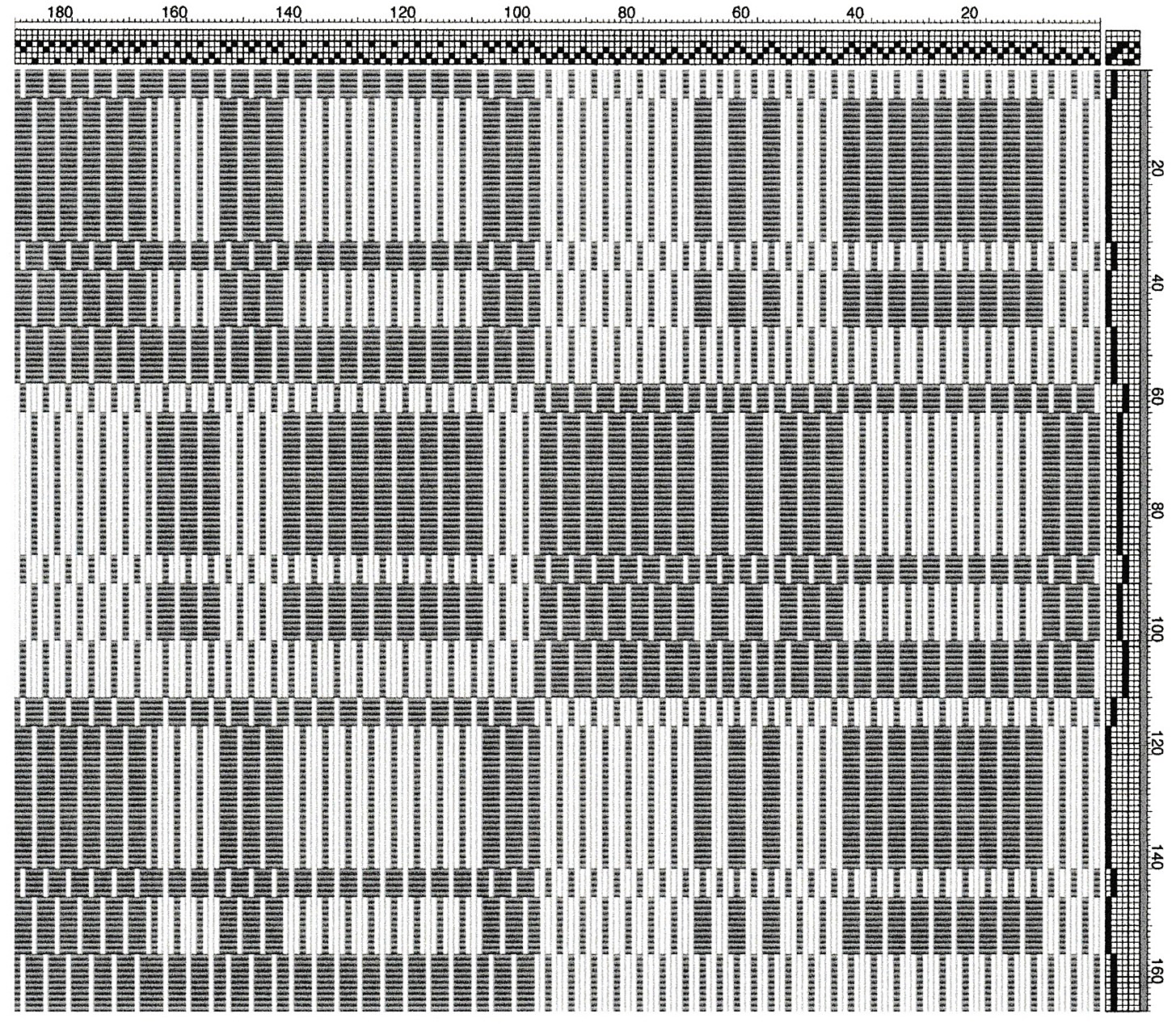
drawdown
Jane Stafford calls these transition threads “incidentals.” She says “… we must insert the incidental thread for the unit we are leaving to preserve our ability to get a plain weave ground. When we skip a block… i.e: move from Block B to D (omitting C), we have to insert the incidental thread that belongs to the unit WE ARE SKIPPING. That means that when we work with opposites…” (as I have in the Tidball threading) “… we have two incidental threads at the centre. The incidental for each unit is the first thread of that unit.”
If you look at the Tidball threading, note that the skip is from block A to block C just before thread #100. That represents the skip of Block B (and its incidental) plus the added incidental for Block C. Visually, the pattern, threadwise, reverses and looks like the original’s opposite.
For this sample’s weaving, I treadled it as Overshot and inserted plain weave picks in between. As is generally the case, the warp threads and the plain weave threads are smaller than the Crackle pattern yarn. As you can see, I used 6 shafts and 6 treadles. The warp for this sample is 190 ends with 165 weft picks.
Bio:

Marianne learned to weave from Carol Jorstad at the University District WEAVING WORKS almost 20 years ago and joined the Weavers’ Guild shortly thereafter. Since then, she’s taken a number of workshops and, during Covid, spent a year learning an enormous amount from the SWG sponsored Weaving Structure Zoom class. She’s taken part in the SWG holiday sale a number of times and since moving to Poulsbo, has sold her handwovens at the Bainbridge Island Museum of Art and the Bloedel Reserve. She’s also a member of the Tapestry Zoom weekly “meeting” which has opened up a whole new avenue of learning. She couldn’t be happier!