May 2026: Ravenstail Treasure Box with Simple Selvage Border
Woven by Sarah Kaltsounis
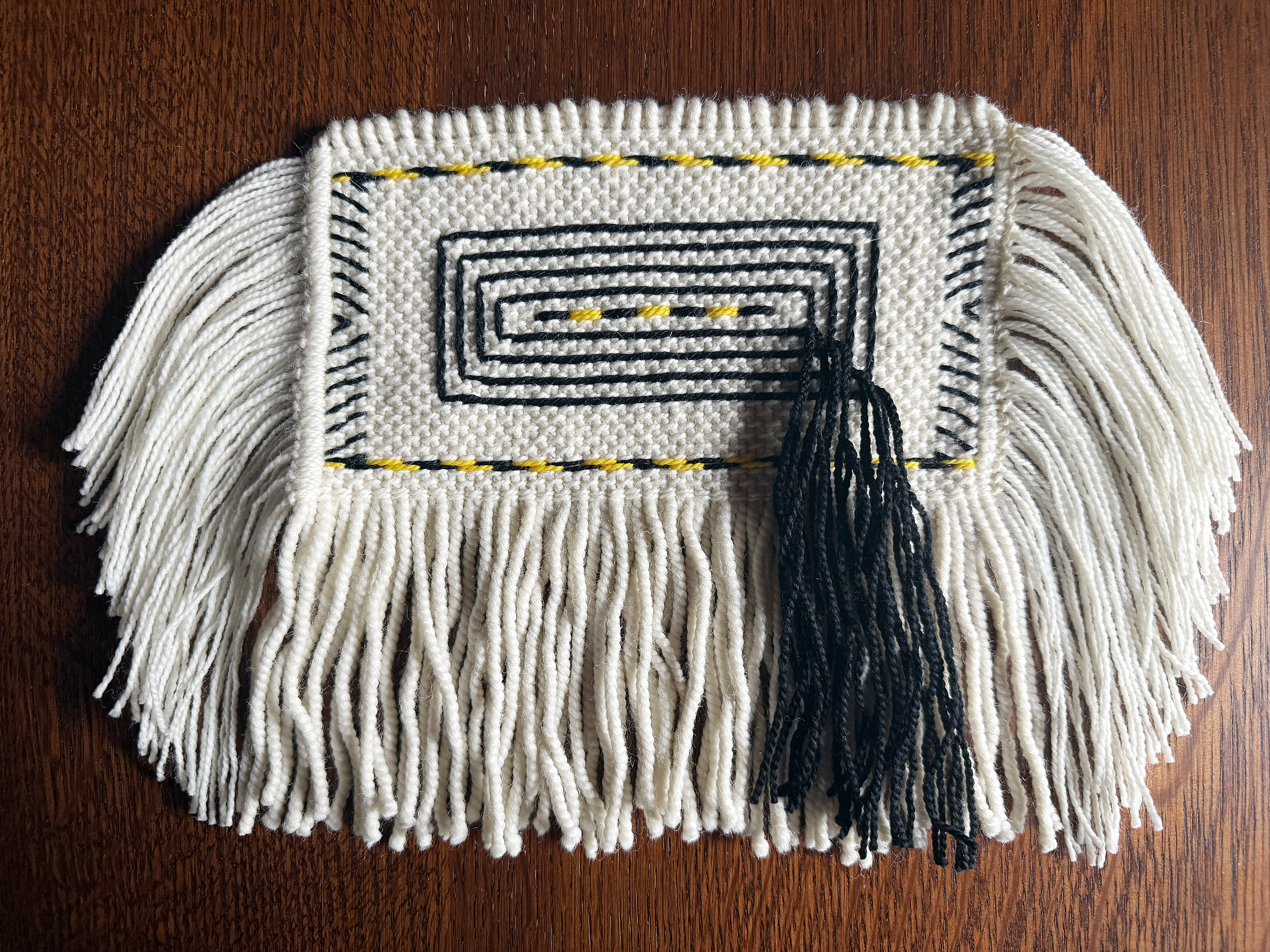
The geometric hand-twining techniques of Ravenstail weaving, borrowed from and inspired by basket weaving, were developed by Tlingit, Haida, Tsimshian, and Nisga’a communities along the northern Northwest Coast. This tradition was nearly lost due to the harmful effects of colonization but has been revived since the 1980s. Weavers and textile researchers who study the few remaining robes, fragments, and illustrations scattered in museums around the world have identified around nine types of stitches that combine in various ways to create ceremonial regalia.
This month’s weaving sample employs the simplest of those techniques (two-strand twining, three-strand twining, and spiral weft), and features designs drawn from my current project, a reproduction of a Ravenstail robe that explorer Gerasim Grigoryevich Izmaylov brought from Alaska in 1788 to the Kunstkamera Museum of Anthropology and Ethnography in St. Petersburg, Russia, where it is still intact and resides to this day. This sample allowed me to practice the selvage stitches that run in a thin border along the robe’s outer edges, and a scaled-down version of the concentric “treasure box” motifs.
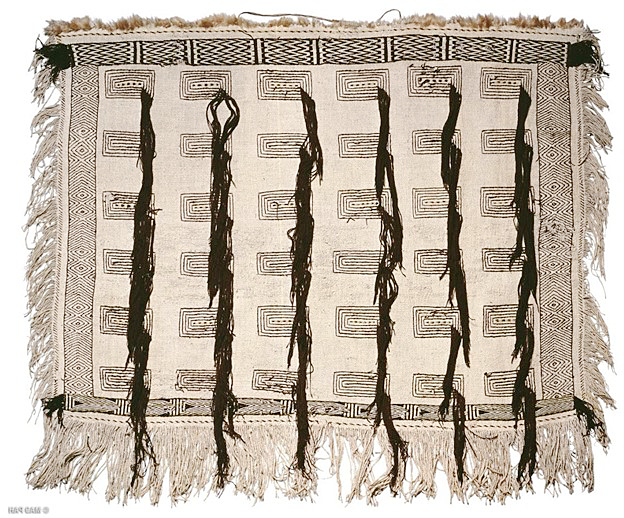
Original circa 1788 mountain goal wool robe.
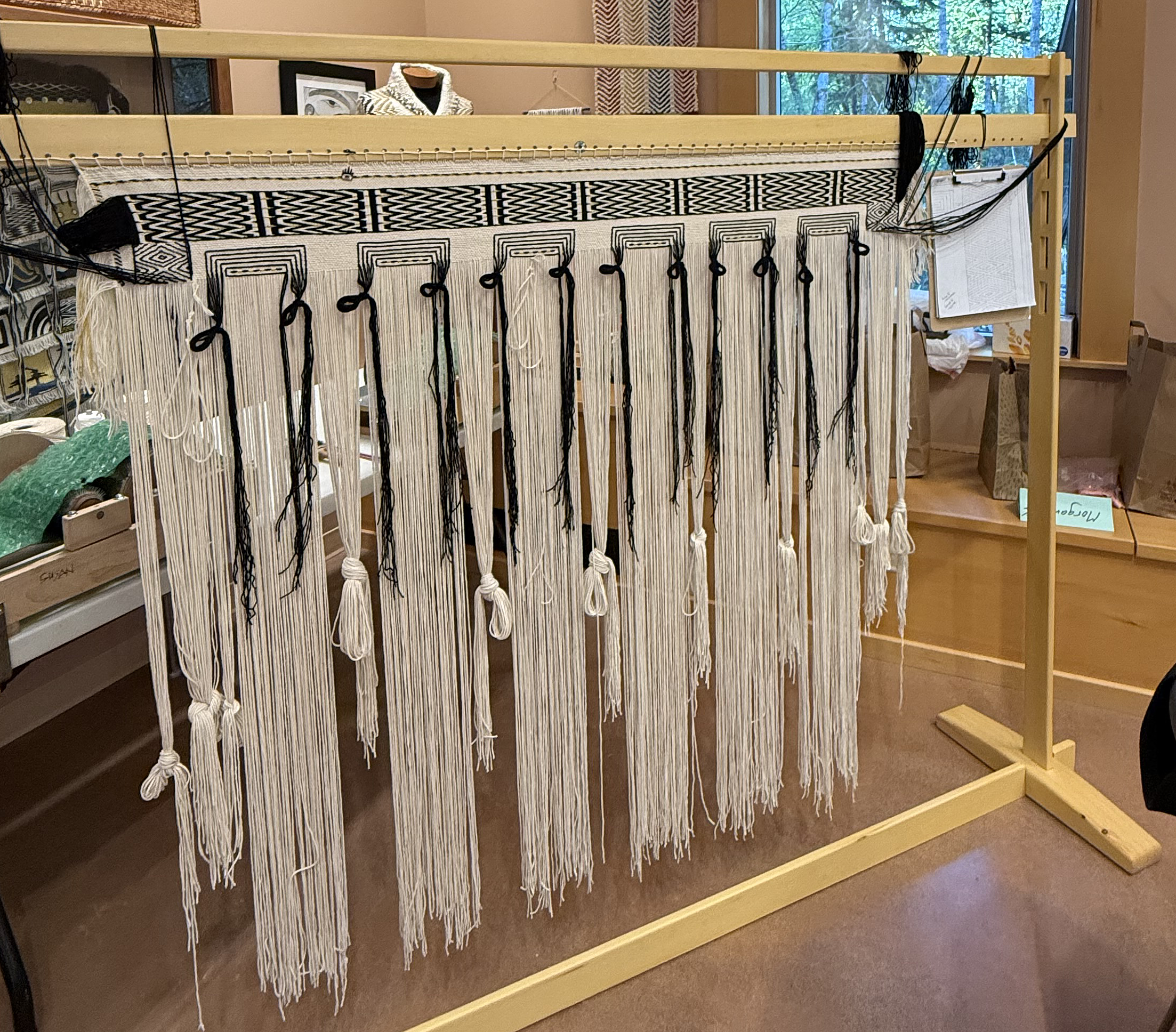
My in-progress reproduction, made of merino wool.
I have been working on this robe in community with other local Northwest Coast weavers who are also making full-size robes. We’ve been hosted by Evergreen State College’s s'gʷi gʷi ʔ altxʷ: House of Welcome Indigenous Arts Campus, in the Paimārire Fiber Arts Studio.
My robe will be gifted to the local Tlingit and Haida community here in Washington, as a form of symbolic rematriation of a historic textile that few will ever get to see in person.
To learn more about Ravenstail weaving, check out the Guild library’s copy of The Raven’s Tail by Cheryl Samuel. I also invite you to watch a 2024 presentation, The History of Ravenstail, by SWG Guild member Ksm Lx'sg̱a̱n Ruth Hallows (starting at time stamp 10:30).
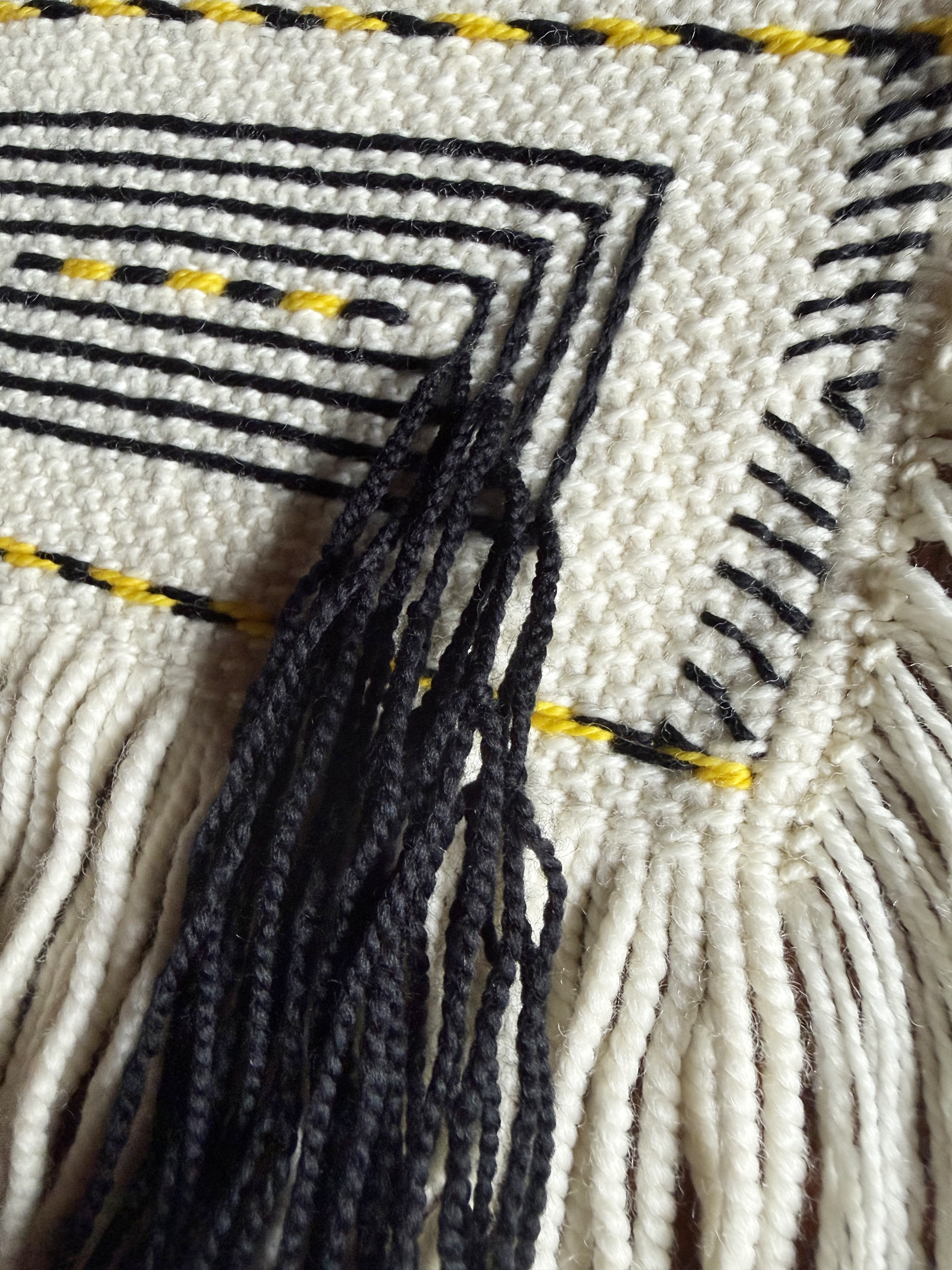
Warp: Wheel-spun merino wool from Kay Parker, a Ravenstail weaver and teacher in Juneau, Alaska.
Weft: Fingering-weight merino wool yarn (I used Indie Dyer Gems Two in natural/undyed, black, and hand-dyed yellow).
Weave structures: Two-strand twining (two-color compact twining and alternate spaced twining), three-strand twining, and spiral weft.
Sett: 9 EPI.
Loom: Northwest Coast gravity-hung bar loom with holes every 1” (mine was made by Fairweather Woodworks of Juneau, Alaska).
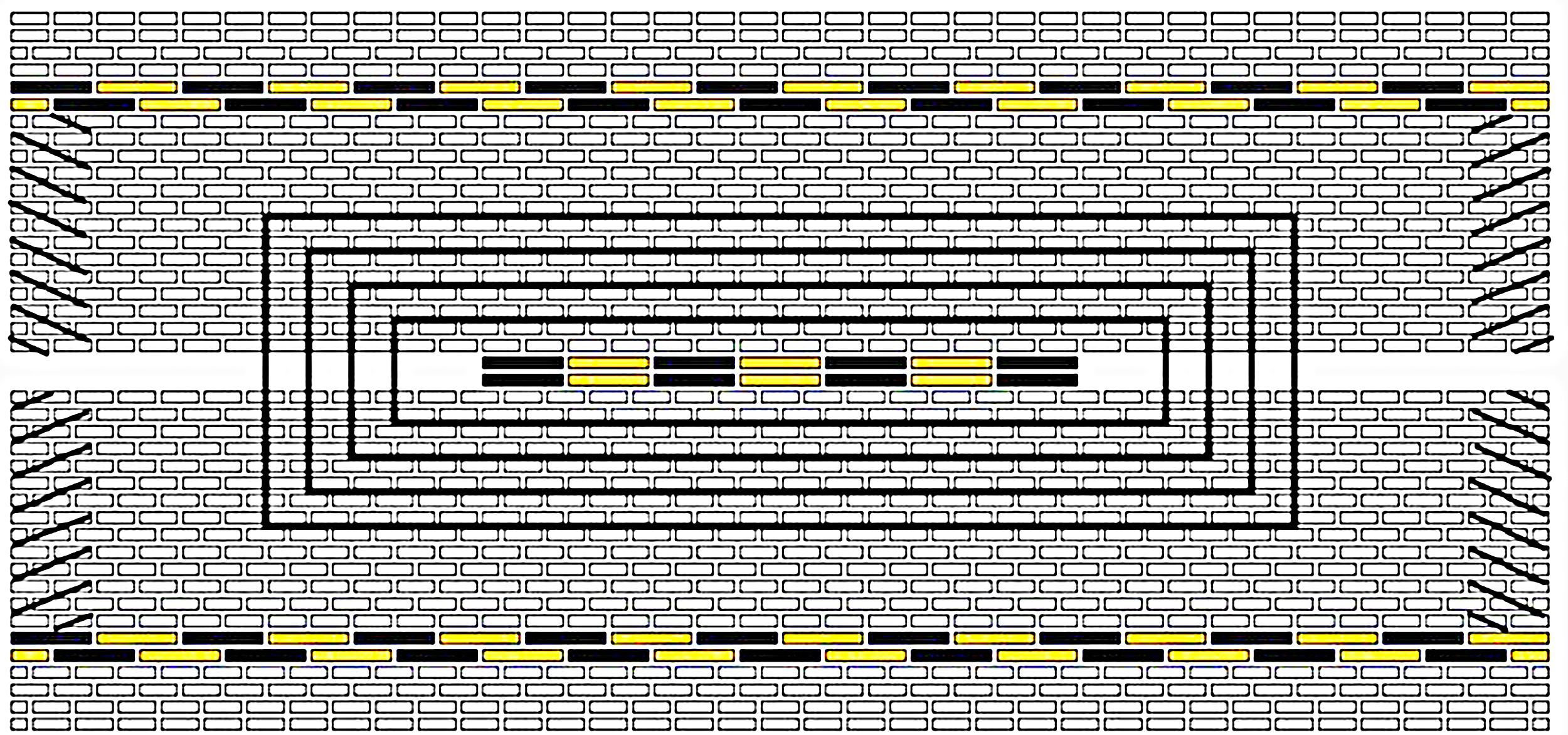
Ravenstail Treasure Box with Simple Selvage Border Drawdown
Ravenstail weaving does not easily lend itself to traditional charting techniques or software programs, but its modern practitioners have figured out creative ways to share information using graph paper or spreadsheet programs like Excel along with descriptive notes about the weaving’s components. What follows is the way I’d describe this piece to a fellow Ravenstail weaver who wanted to duplicate it:
• Materials and set-up: 17.5 yards of 9 EPI warp, cut two 24” header cords and thirty-six 16” warps. Dress loom 8” across, folding nine warps over every 2” (alternating 5-4-5-4-5-4-5-4). Seventy-two warp ends total.
• Header (the part of the weaving that is often covered by fur or leather trim): Work two rows of stacked stitches to set folded warp pairs, followed by two rows of alternate spaced twining.
• Top and bottom selvage lines: Two rows offset black and yellow two-strand compact twining over four stitches, ends worked in a 4-strand chevron braid on the back side to secure.
• Side selvages: Black spiral weft worked over four warps, switching after every row.
• Central design field: Six rows of alternate spaced twining above and below treasure box, eight warps on each side. Make four concentric boxes with black three-strand twining, two rows horizontally and two warps vertically between each box. Finish black fringes on the front with one inch of braid and five inches of fringe. “Day and Night” center with stacked black and yellow four-warp stitches (BYBYBYB), ends worked in a 4-strand chevron braid on the back side to secure.
• Footer: Two rows alternate spaced twining followed by two rows of stacked stitches.
• Weft (side) fringes: 4” long, attached on the left with half-hitch knots, and on the right by securing each row’s weft ends with an overhand knot.
• Warp (bottom) fringes: 4” long.
Here’s one way to represent each row, braid, and diagonal spiral weft stitch, using Excel, though most Ravenstail weavers would probably not use a chart or graph for a project like this.
About Sarah:

Gagaan Sarah Kaltsounis learned Ravenstail and Chilkat weaving from two Tlingit weavers and artists, Wooshkindein Da.áat Lily Hope and Shaadootlaa Iyall. She completed a year of advanced Ravenstail study through the University of Alaska Southeast - Sitka.
Her woven regalia can be found at the Juneau-Douglas City Museum, at the Tlingit Culture, Language, and Literacy (TCLL) school program in Juneau, accompanying the Ravenstail and Chilkat Pride robes at Juneau’s Zach Gordon Youth Center, and being worn in performances by members of the Alaska Kuteeyaa Dancers and the Tlingit & Haida Elders Dance Group.
Sarah was adopted into the Tlingit Wooshkeetaan clan (Eagle/Shark) by her friend and fellow weaver Kukandagéin Davina Barril. Her Tlingit name Gagaan means “sunshine”.