Woven by Sarah Kaltsounis
For last May’s Bulletin Sample, I shared my study of some of the techniques used to weave a reproduction of a historical Ravenstail robe taken from Tlingit lands in Alaska in 1788 and now housed in the Kunstkamera Museum of Anthropology and Ethnography in St. Petersburg, Russia.
This month’s Sample focuses on a different part of the robe: the top border. Its striking pattern consists of segments of zig-zags sandwiched between vertical bars. Modern weavers have named it the “All Our Ancestors” pattern. It appears as the top border on most of the surviving old Ravenstail robes woven in this style and remains extremely popular to this day for headdresses and other ceremonial regalia.
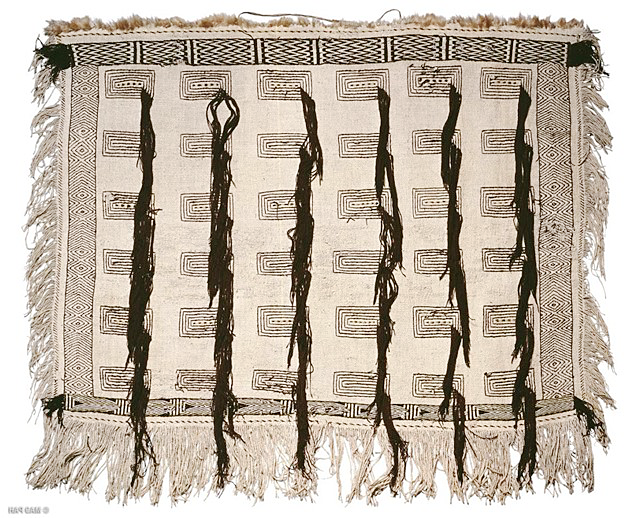
Original circa 1788 mountain goal wool robe.
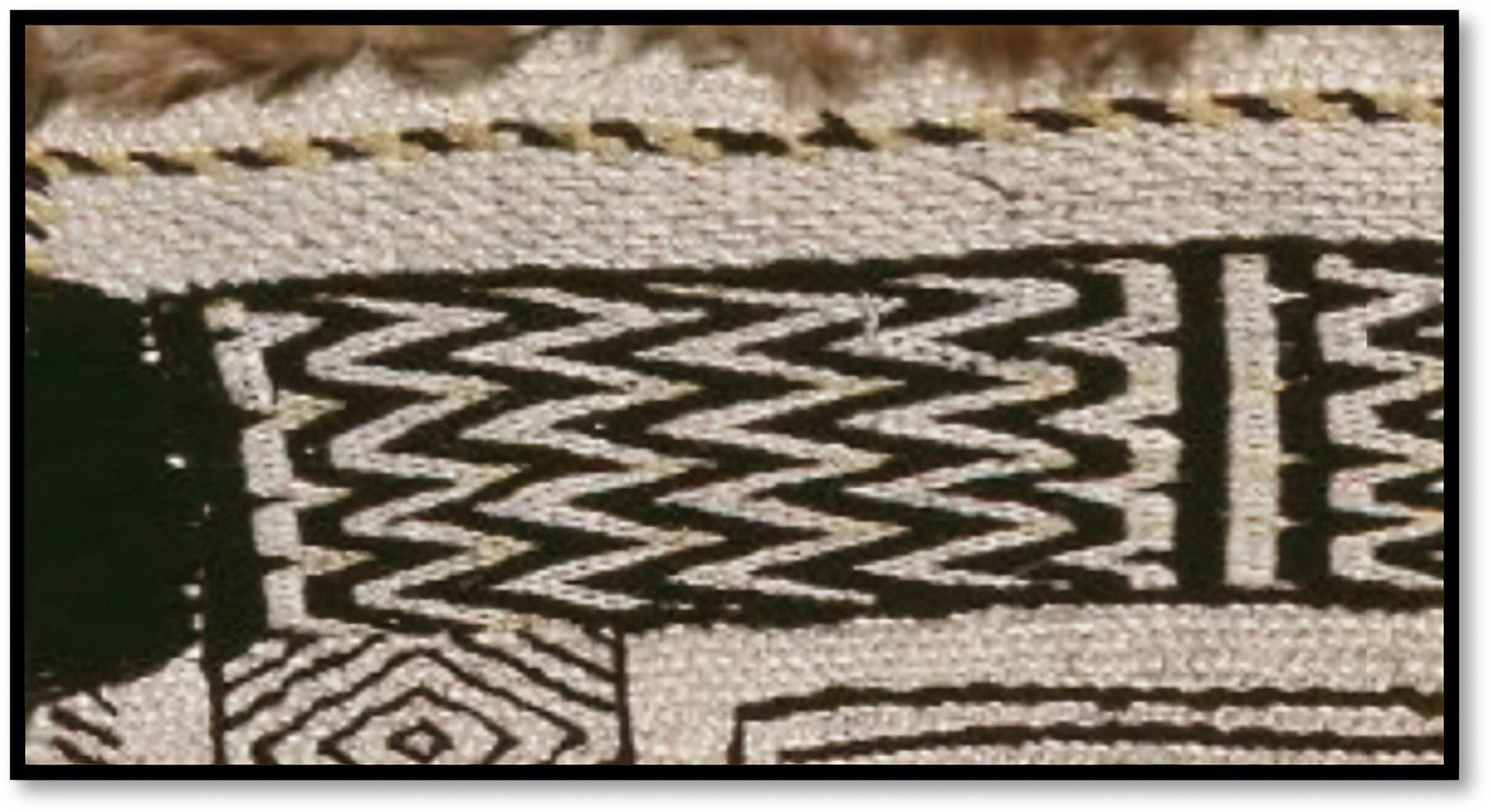
Closeup view of top border segment.
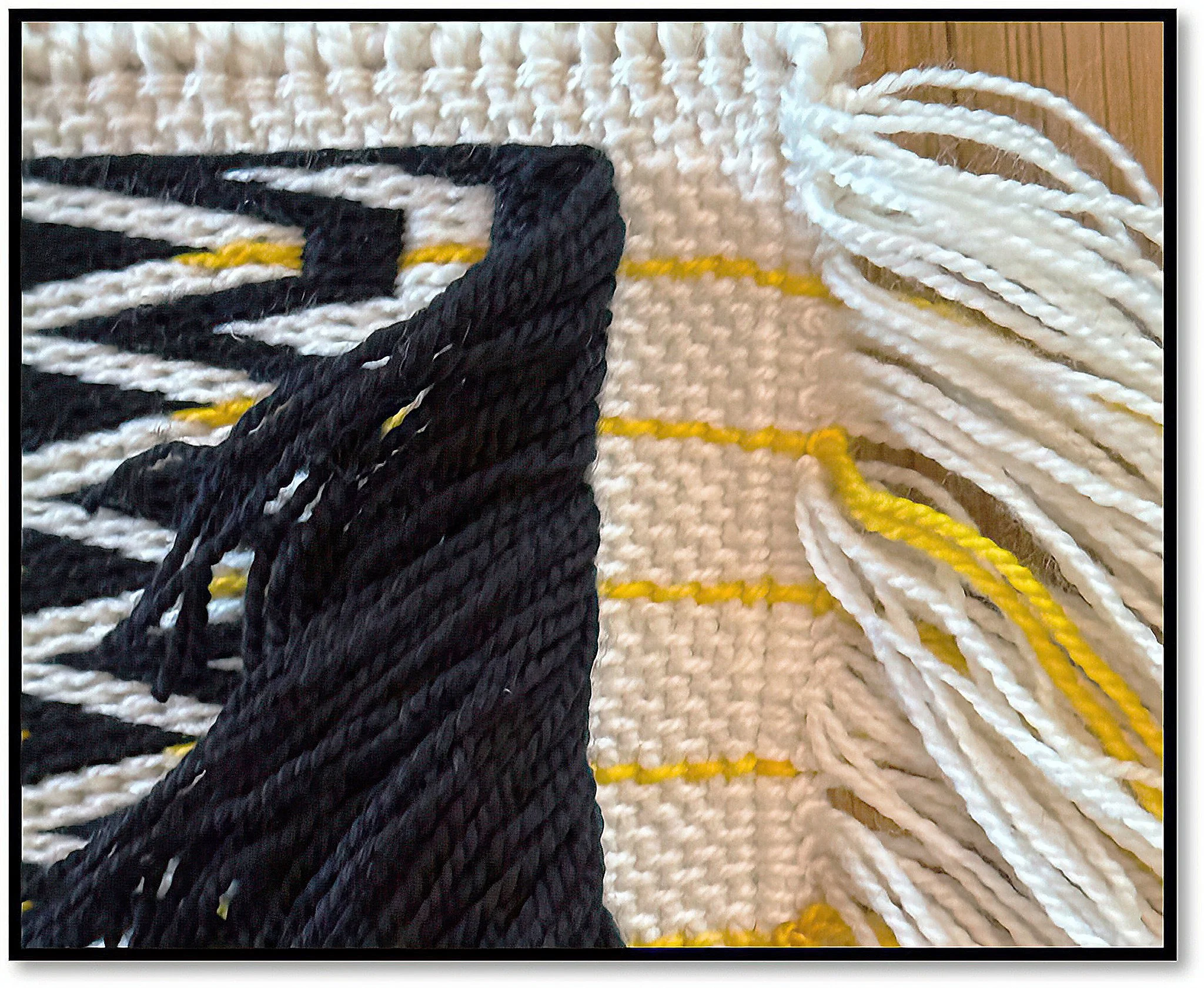
The technique used to create these dense border patterns is known as compact twining, because each row of weaving is pressed up against the one above it—a contrast to the space-twined weaving in the robe’s center, where a bit of space is left above and below each row that allows the warp cords to peek through. No warp is visible in a compact-twined border.
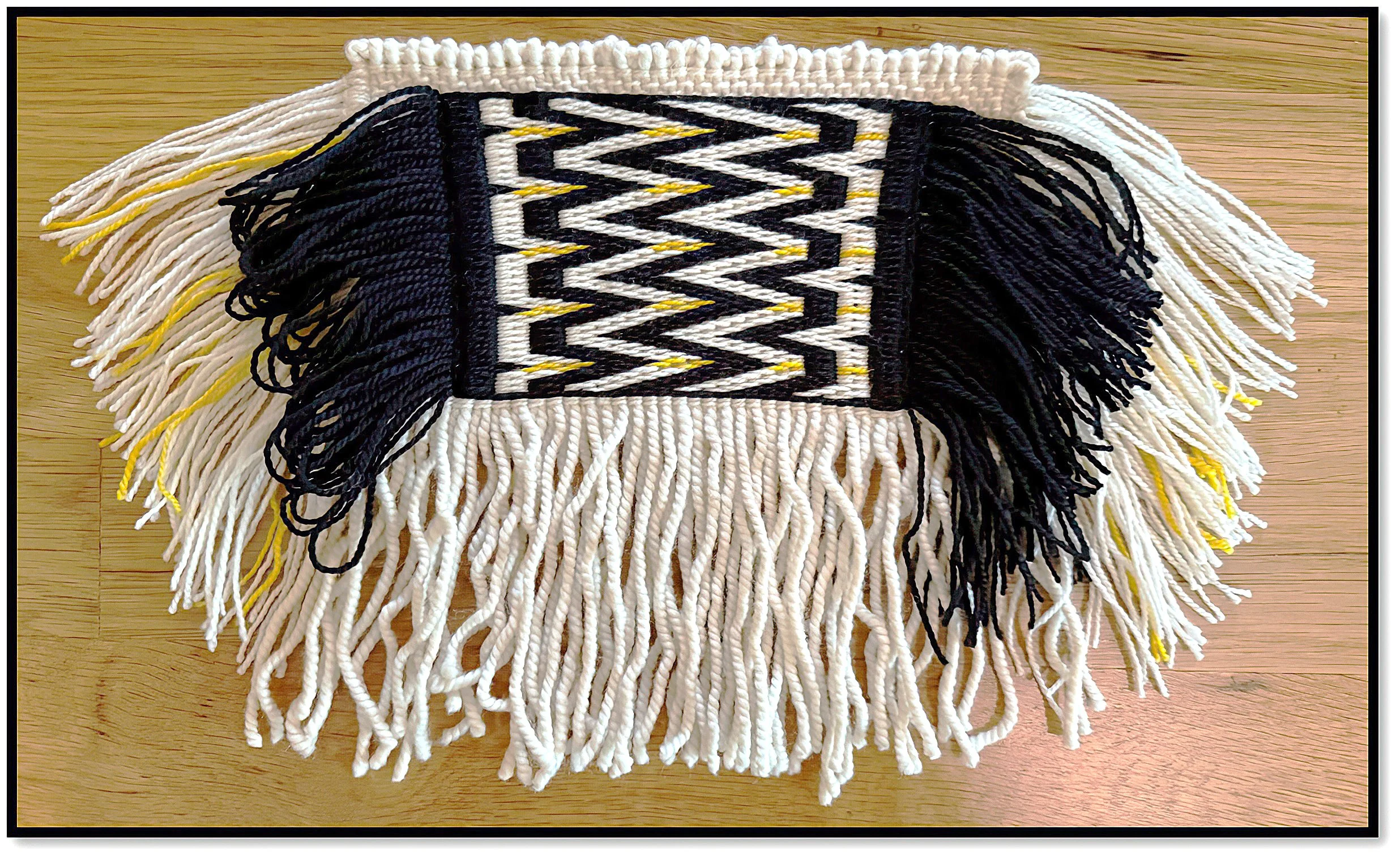
Ravenstail border sample
Each row begins with a white weft strand, folded in half and twined across the selvage margin until the pattern design begins. At that point, a black weft strand is inserted; a few inches of its folded center remain hanging from the front of the robe as a loop of fringe. Then each end of the black weft is paired with an end of the white weft and weaving proceeds across the robe to the right. When the two neighboring rows are complete, the two black weft ends reunite and are pulled to the robe’s front to create another black fringe, while the two white weft ends rejoin to twine across the remaining selvage margin until they reach the end, at which point they’re knotted together to form a white fringe.
Compact twining stitches are made over two or four warps and are always staggered like bricks. Modern Ravenstail weavers use Excel spreadsheets to chart these patterns. The sample I’ve made here is a scaled-down version of the segments used in the original robe; those are around 72 warps wide, but the chart below is for a 56-warp segment.
Warp: Wheel-spun merino wool from Kay Parker, a Ravenstail weaver and teacher in Juneau, Alaska
Weft: Fingering-weight merino wool yarn (I used Indie Dyer Gems Two in natural/undyed, black, and hand-dyed yellow).
Weave structure: Compact twining
Sett: 9 EPI
Loom: Northwest Coast gravity-hung bar loom with holes every 1” (mine was made by Fairweather Woodworks of Juneau, Alaska)
CLICK FOR “All Our Ancestors” Drawdown
About Sarah:

Gagaan Sarah Kaltsounis learned Ravenstail and Chilkat weaving from two Tlingit weavers and artists, Wooshkindein Da.áat Lily Hope and Shaadootlaa Iyall. She completed a year of advanced Ravenstail study through the University of Alaska Southeast - Sitka.
Her woven regalia can be found at the Juneau-Douglas City Museum, at the Tlingit Culture, Language, and Literacy (TCLL) school program in Juneau, accompanying the Ravenstail and Chilkat Pride robes at Juneau’s Zach Gordon Youth Center, and being worn in performances by members of the Alaska Kuteeyaa Dancers and the Tlingit & Haida Elders Dance Group.
Sarah was adopted into the Tlingit Wooshkeetaan clan (Eagle/Shark) by her friend and fellow weaver Kukandagéin Davina Barril. Her Tlingit name Gagaan means “sunshine”.